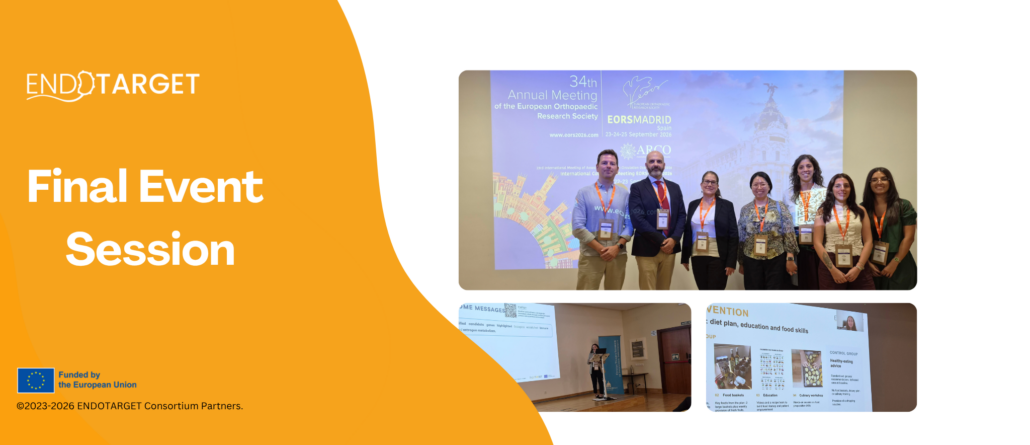
ENDOTARGET Final Event at the EORS 2026
As ENDOTARGET approaches the conclusion of its research journey, the project marked an important milestone by hosting a dedicated scientific session at the European Orthopaedic Research Society (EORS) 2026 conference in Madrid, Spain. Titled “Uncovering the Gut–Joint Axis: The Role of Gut Microbiome and Endotoxemia in the Arthritic Joint”, the session brought together researchers from across the ENDOTARGET consortium to present new findings on how gut health may influence rheumatic disease development, progression, and treatment.
Over recent years, growing evidence has suggested that the gut and the joints are more closely connected than previously thought. Changes in the gut microbiome, increased intestinal permeability, and the presence of bacterial inflammatory-active compounds in the bloodstream may contribute to inflammatory processes that affect joint health. The ENDOTARGET session explored these links from multiple scientific perspectives, ranging from population studies and in vitro research to clinical interventions and precision medicine.
The session opened with Gonçalo Barreto (HUS), who presented data from large population cohorts investigating the relationship between endotoxemia, intestinal permeability, and arthritis-related disorders. His work highlighted how large-scale human data can help identify factors that may contribute to disease risk and progression.
Building on this theme, Rodolfo Gómez (SERGAS) discussed emerging pharmacological and surgical approaches aimed at reducing the impact of endotoxemia on osteoarthritis. The presentation showcased innovative strategies that could help address inflammatory mechanisms associated with joint degeneration.
In vivo animal research was presented by Shipin Zhang (ETHZ), who examined sex differences in inflammatory responses and arthritis development in animal models exposed to lipopolysaccharide, a bacterial molecule linked to endotoxemia. The findings underline the importance of considering biological sex when studying disease mechanisms and developing future therapies.
Nutrition was another key focus of the session. Sofia Charneca (GIMM) presented results from the TASTY Trial, a dietary intervention study in people with rheumatoid arthritis. The research explored how nutritional approaches may influence inflammation and disease outcomes, reflecting the growing interest in lifestyle-based strategies to support patient care.
The potential of microbiome-targeted therapies was discussed by Reetta Satokari (UH), who presented work on faecal microbiota transplantation in axial spondyloarthritis. Her findings contribute to a rapidly evolving field that seeks to restore a healthy microbial balance as a way of influencing disease activity.
Finally, Galadriel Silva (UTARTU) presented a large-scale genome-wide association study meta-analysis that identified new genetic loci linked to rheumatoid arthritis and improved disease risk prediction in the Estonian Biobank. The study demonstrates how genetics and population health data can support earlier and more personalised approaches to disease prevention and management.
Together, the six presentations illustrated the breadth of ENDOTARGET research, from fundamental biological mechanisms to potential therapeutic and preventive solutions.
Beyond the dedicated ENDOTARGET session, consortium partners also shared project results across several other conference sessions, demonstrating the broad scientific impact of the project.
In the symposium “Organotypic Microphysiological Systems to Study Musculoskeletal Pathologies and Develop Regenerative Therapies”, Eva Ingeborg Rheins (TU Wien) presented a novel human synovial biochip model that investigates how mechanical stress influences inflammatory responses to gut-derived bacterial toxins. This innovative platform offers new opportunities to study disease mechanisms in a human-relevant setting.
Researchers from SERGAS contributed several presentations highlighting new therapeutic and translational approaches. Lorena Zas Veiga presented research showing that the molecule miR-146a-5p can reduce inflammation and improve responses to corticosteroid treatment in musculoskeletal disorders. Ana Alonso Pérez presented work on optimising laser treatments for titanium implants to influence inflammation and bacterial colonisation, as well as research identifying risk factors and sex-specific predictive models for heterotopic ossification following hip arthroplasty. The connection between gut and joint health was further explored by María Crugeiras Sampedro, who presented research examining the dual contribution of gut-derived and joint-specific pathways in the development of osteoarthritis and rheumatoid arthritis.
Together, these presentations demonstrated the multidisciplinary nature of ENDOTARGET, bringing together expertise in microbiome research, immunology, genetics, nutrition, bioengineering and clinical medicine.
The EORS 2026 session provided an excellent opportunity to share ENDOTARGET’s achievements with the wider scientific community and to foster discussions on future directions in gut–joint axis research. As the project reaches its final stages, these results contribute to growing knowledge that may help pave the way towards more personalised and effective approaches for preventing and managing rheumatic diseases.