Unlocking Insights from Complex Health Data: Highlights from the 4th ENDOTARGET Webinar
On the 10th of September 2026, the ENDOTARGET project hosted its 4th webinar, “Challenges of Noisy and Sensitive Biobank Data.” The event brought together experts in bioinformatics, artificial intelligence, data science, data protection and ethics to explore how researchers can extract meaningful insights from large health datasets while ensuring privacy, ethics and scientific reliability.
The webinar began with an introduction to the ENDOTARGET project by Lena Schleicher from the Steinbeis Europa Zentrum. The project investigates how changes in the gut microbiome, microbiome-derived compounds and intestinal permeability may contribute to chronic inflammation and rheumatic disease onset. Given the vast amount of biological and clinical data generated within the project, advanced computational approaches play a crucial role in identifying meaningful patterns.
How to uncover hidden links between the gut microbiome and osteoarthritis?
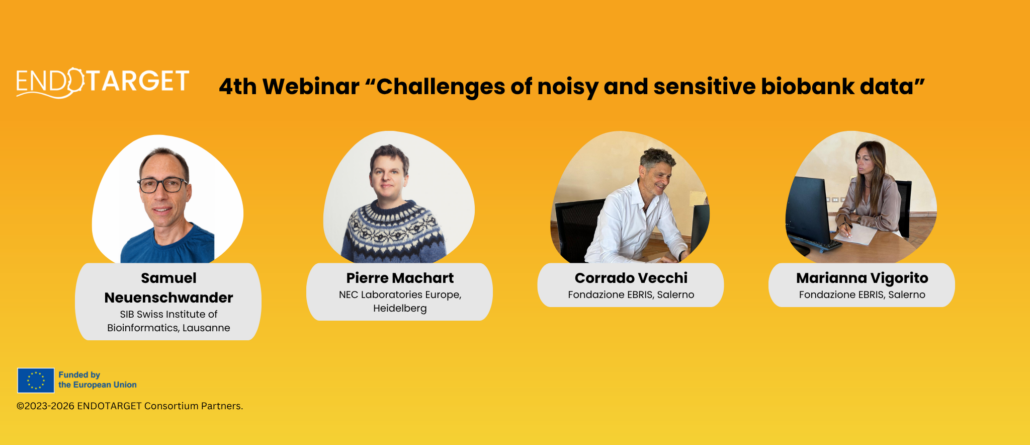
The first presentation, delivered by Samuel Neuenschwander from the Swiss Institute of Bioinformatics, introduced an innovative diffusion-based method for analysing microbiome data. Traditional approaches often rely on existing annotations, which cover only a fraction of the microbial genes and proteins present in the gut microbiome. To overcome this limitation, the researchers developed a network-based approach that analyses microbial proteins without relying on pre-existing annotations. Using data from the Estonian Biobank, FINRISK and TwinsUK cohorts, the method identified strong microbiome signals associated with factors such as age, sex, body mass index and zonulin (a protein that regulates intestinal tight junctions, thereby controlling intestinal permeability). Evidence linking the microbiome directly to osteoarthritis was weaker, but a potential signal was detected in the Estonian cohort, highlighting the value of exploring new analytical approaches.
Why does cohort size matter for disease prediction?
The second presentation by Pierre Machart from NEC Laboratories Europe focused on the challenges of predicting disease development using biobank data. Using the FINRISK cohort, the team investigated whether machine-learning models could predict future rheumatoid arthritis (RA) cases. The analysis identified several factors associated with RA risk, including age, some comorbidities and inflammatory markers. However, despite having thousands of participants and hundreds of variables, the number of individuals who later developed RA was relatively small. This limited the statistical power of predictive models. While the models could identify patterns within the existing data, they were unable to accurately predict disease development in new individuals. The key lesson was clear: successful prediction depends not only on the overall size of a dataset but also on having sufficient numbers of disease cases, high-quality data and adequate overlap between different data types.
How can sensitive health data be protected?
The final presentation was delivered by Marianna Vigorito and Corrado Vecchi from the European Biomedical Research Institute of Salerno (EBRIS), who discussed privacy, ethics and data governance in biomedical research. The speakers explained how the General Data Protection Regulation safeguards personal health data and outlined measures used within ENDOTARGET, including pseudonymisation, informed consent, access controls and secure data management. These safeguards allow researchers to analyse sensitive clinical and biological information while protecting participant privacy. The discussion also addressed the growing role of AI in medicine. While AI offers great potential for precision medicine, it also raises concerns about bias, fairness and transparency. ENDOTARGET addresses these challenges through an “ethics-by-design” approach, ensuring that ethical considerations are integrated throughout the entire research process rather than being treated as an afterthought.
Key takeaways
The 4th ENDOTARGET webinar highlighted that generating useful insights from biobank data requires more than sophisticated algorithms. High-quality data, robust study design, sufficient statistical power and strong ethical safeguards are all essential for translating complex biological information into meaningful scientific discoveries.
Missed the webinar or want to rewatch it? Find the recordings here: Communication Material – ENDOTARGET